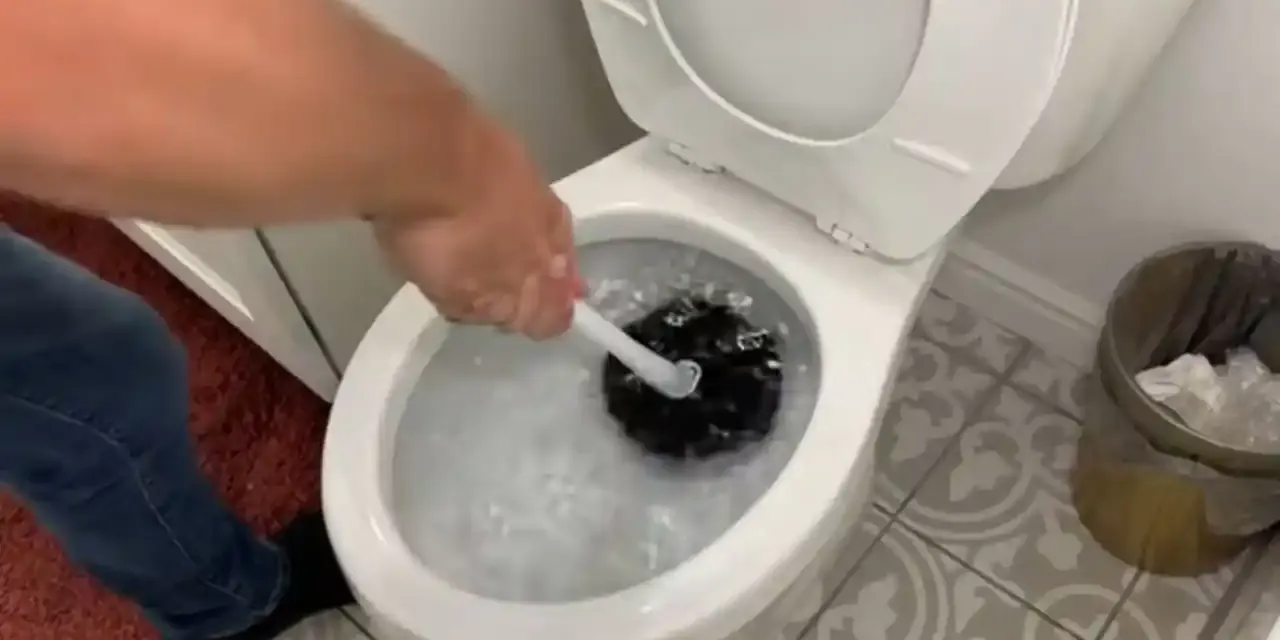
First, keep the bowl from overflowing
Do not flush again. Each flush sends another 1.6 gallons or more into a bowl that is already full. Lift the tank lid, push the rubber flapper down, and turn the oval handle on the supply line behind the toilet clockwise to stop the refill.
Lay old towels around the base and put on rubber gloves. Then look at the water level. If it sits near the rim but is not moving, you have time to work. If it is rising, close the flapper and call a plumber who handles toilet repair and installation.
Plunging the right way
Most clogs are toilet paper and waste jammed in the trap, the curved passage built into the base. A plunger moves that plug with water pressure, not suction alone.
- 1
Pick a flange plunger
It has a rubber sleeve that folds out of the cup. The sleeve seats in the drain opening. A flat sink plunger will not seal in a toilet bowl.
- 2
Check the water level
The cup must be covered with water. If the bowl is low, add water from a bucket until it covers the rubber. Never use boiling water, since it can crack the porcelain.
- 3
Seat it and push gently
Press down slowly once to push the air out of the cup. A hard first push splashes dirty water onto the floor.
- 4
Pump 15 to 20 times
Keep the seal and use short, firm strokes with the pull as strong as the push. Then pull the plunger away sharply.
- 5
Test with a half flush
If the water drains fast with a swirl, the clog is gone. If it drains slowly or rises, repeat the plunging up to three rounds before moving on.
When the plunger fails: the closet auger
A closet auger (also called a toilet auger) is a 3 to 6 foot steel cable inside a rigid tube with a curved, rubber-sleeved tip. The sleeve protects the porcelain from scratches. Hardware stores sell them for a modest price. It is the right tool for a plug sitting just past the trap.
Pull the cable back into the tube, set the curved end in the drain opening, and crank the handle clockwise while pushing the cable forward. When the cable stops against a soft plug, keep cranking to hook it or break it up. Retrieve the cable slowly, flush once, and rinse the tool. If the cable runs free for its full length and the water still stands, the clog is past the reach of this tool.
What the symptoms tell you
Where else the water shows up is the best clue about where the clog sits.
| What you see | Likely location | What to do |
|---|---|---|
| Only the toilet is slow, bowl fills to the rim | Trap or the toilet's own drain | Plunge, then use a closet auger |
| Toilet gurgles when the shower or sink drains | Branch line shared with other fixtures | Stop using water and call a plumber |
| Water rises in the tub or shower when you flush | Main line or lateral | Stop all water use and call right away |
| Every toilet in the house is slow | Main line | Call for a camera inspection |
| Clogs come back within days | Partial blockage, roots, or a bellied pipe | Ask for a camera look, not another plunge |
| Something hard was dropped in, like a toy | Trap, jammed object | Skip the plunger and call, force can wedge it |
These are general patterns. A camera inspection is the way to confirm the cause.
How to tell a main-line problem
Your toilet is the highest drain in many homes, but the lowest fixture shows trouble first. A basement or ground-floor tub that backs up when the toilet flushes points to the main line, the large pipe, usually 4 inches wide, that carries every drain out of the house.
Plunging a main-line clog does nothing and can push sewage through the lowest drain in the house. Stop running water, keep the kids and pets away from any wet floor, and call for a snake or a drain cleaning visit with a camera.
Who owns the pipe in Mauldin
In October 2024 the City of Mauldin Public Works Committee agenda described the city sewer system as consisting only of mainlines and manholes within street rights-of-way and utility easements. The lateral, the pipe from your house to that mainline, belongs to and is maintained by the property owner.
That matters on a bad night. A main-line clog at your house is usually yours to fix, even if the pipe runs under the yard or the curb. Call a plumber first to find where the blockage is, and call the city only if the camera shows the problem sitting in the mainline itself.
Mauldin grew after Greenville Water lines reached Laurens Road in 1953 and US 276 was built through the center of town in 1956. Homes here were built across several decades, so a lateral can be old or fairly new. If the same toilet clogs again after a clean clearing, a camera look at the lateral is cheaper than a third emergency call.
Source type: City of Mauldin Public Works Committee agenda (Oct 2024) and city history page.
Call a plumber instead of continuing when
Stop the DIY work and call (855) 575-2890 if any of these are true.
- Water keeps rising after the plunger and a half flush.
- More than one drain gurgles or backs up.
- The auger meets a hard stop and will not turn.
- Sewage appears in a tub, shower, or floor drain.
- The toilet rocks or leaks at the base after you pull it.
- You have cleared the same toilet more than twice in a month.
Never pour chemical drain opener into a standing toilet. It sits on the clog, can burn skin during the next attempt, and can damage the finish. Call (855) 575-2890 and tell the dispatcher what you already tried.
What not to flush afterward
Wipes labeled flushable do not break up like toilet paper, and they hang on roots and rough pipe joints. Paper towels, cotton swabs, dental floss, and feminine products belong in the trash can. A regular household toilet is built for waste and toilet paper only.
Use a thinner wad of paper per flush, and keep the tank's fill valve working. A low flush that leaves the bowl weak is a toilet problem, and a plumber can adjust or replace the parts.
The same steps apply if you live just outside the city line. Our dispatch also covers Simpsonville and Greenville, where the question of who owns the lateral may have a different answer, so ask the local sewer provider.
Clogged toilet questions from Mauldin homeowners
It can help. Squeeze a few tablespoons of liquid dish soap into the bowl and let it sit for 15 minutes with warm tap water. The soap lubricates the plug. It will not dissolve a solid object.
Try three rounds of 15 to 20 pumps each. If the bowl is no better after that, move to the closet auger. If the auger meets nothing, call a plumber.
No. The liquid pools on top of a full bowl and can splash back onto you if you plunge afterward. It also works poorly on paper and waste.
A partial blockage downstream, tree roots in the lateral, a sag in the pipe, or a weak flush is the usual cause. A camera inspection shows which one. Repeating the plunge only treats the symptom.
The Mauldin Public Works Committee agenda from October 2024 describes the lateral as belonging to and maintained by the property owner. The city system is the mainline and manholes. A plumber with a camera can show which side the clog is on.
Yes, if the real clog is in the main line. Water has nowhere to go, so it exits through the lowest opening, often a tub or floor drain. Stop using water and call a plumber.
If the water is rising, sewage is reaching the floor, or it is your only bathroom and nothing works, treat it as urgent. The 24/7 line at (855) 575-2890 is open for that.