Start with the meter, because it does not guess
Greenville Water supplies Mauldin from Table Rock Reservoir, North Saluda Reservoir and Lake Keowee, treats it with chloramine, and bills by the meter. Every gallon that escapes inside your wall was treated and metered first, so a leak shows up as use. Greenville Water does not estimate bills except in unusual cases, so a jump on the statement usually means real water moved.
That makes the meter the fastest test you own. The utility keeps the line up to the outlet side of the meter. From there to the house, the pipe is yours to maintain.
A 15-minute check you can do before the plumber comes
Do these in order. Each one narrows the search.
- 1
Stop all water use
Close taps, stop the dishwasher and washer, and turn off the ice maker if you can.
- 2
Read the meter
Lift the lid, note the low-flow dial and the numbers, then wait at least 15 minutes without using water.
- 3
Look again
If the dial or numbers moved, water is going somewhere. If not, the leak may only show under pressure or at certain times.
- 4
Close the house shutoff
If the outdoor meter keeps running with the house valve closed, the leak sits between the meter and the house.
- 5
Dye the toilets
Put food coloring in each tank without flushing. Color in the bowl after an hour or more means that flapper leaks.
Water coming through the ceiling right now
Shut off the house main first, then flip the breaker for any room under the wet spot, since water and wiring do not mix. Poke a small hole in a bulging ceiling bubble over a bucket so it drains in one place instead of letting the whole panel fail. A ceiling or wall stain that keeps spreading is an after-hours call, and the dispatcher can book a same-day visit when one is open.
Where the water goes and how a plumber finds it
Different hiding places call for different instruments.
| Where it hides | Common tell | Method |
|---|---|---|
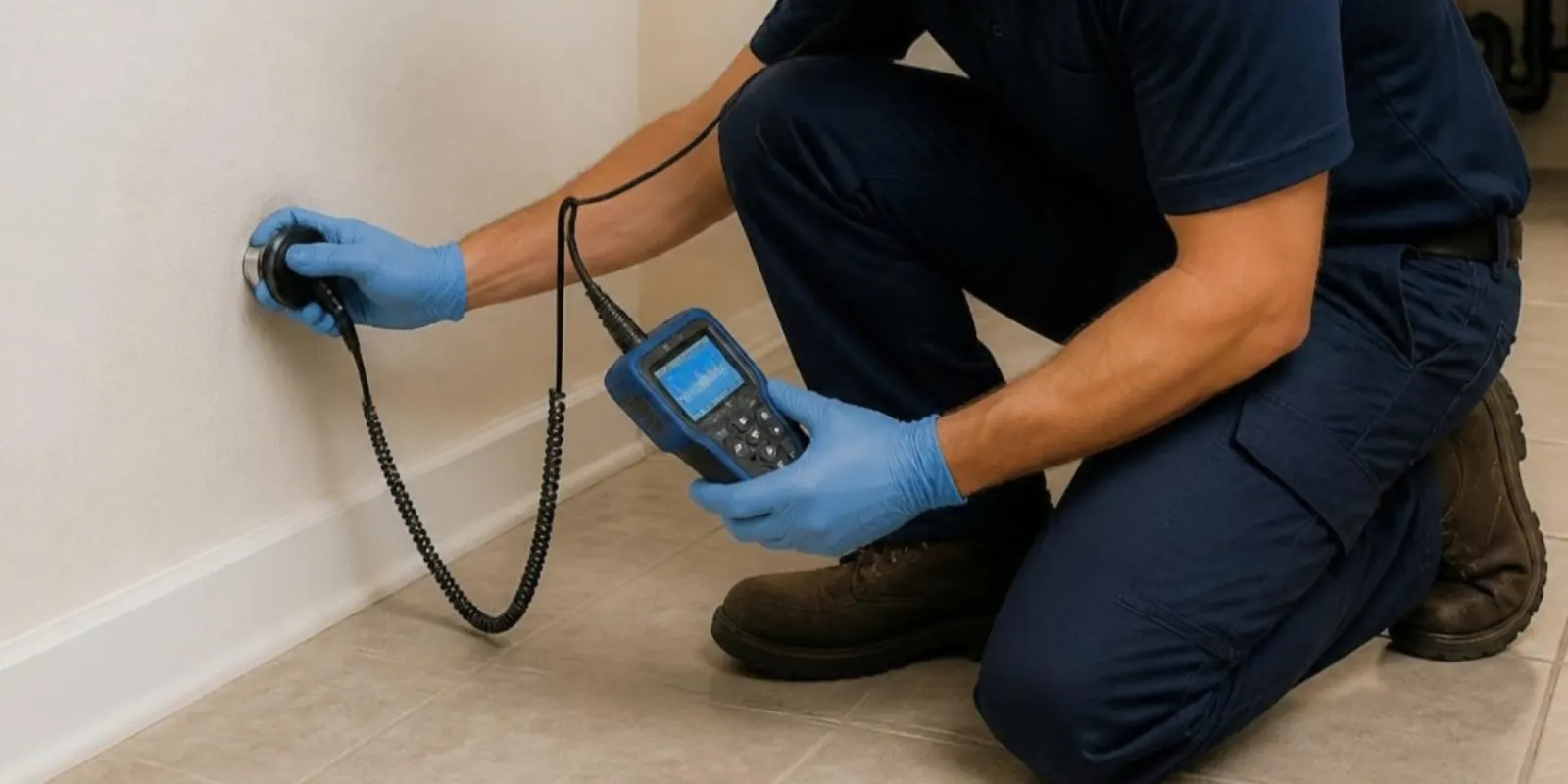
| Wall or ceiling cavity | Stain, soft drywall, musty smell | Moisture meter plus infrared camera |
| Under the house or crawlspace | Damp insulation, sagging subfloor, pooled soil | Visual check, then pressure test of supply lines |
| Buried line, meter to house | Meter spins with house valve shut, soggy patch in the yard | Ground microphone and electronic listening |
| Irrigation system | Low pressure in zones, wet spot near a head or valve box | Zone-by-zone pressure test |
| Under a slab | Warm floor spot, constant hiss, meter movement | Listening gear, then slab leak repair options |
Signs the leak is under the house, in the yard or in a zone
- Floors feel springy or cup near one wall.
- The crawlspace smells like wet dirt even in dry weeks.
- Water pressure drops at the far end of the house but not at the front.
- A patch of lawn stays green and soft while the rest dries.
- One irrigation zone sprays weakly or the valve box is full of water.
If three or more of these match, tell the dispatcher. It changes which tools get loaded on the truck.
What Greenville Water's meter rule means for a Mauldin leak
Greenville Water maintains the line up to the outlet side of the meter, and the line leaving it is the customer's to maintain. So a leak found beyond the meter is repaired at the owner's cost, while a problem at the meter itself goes to the utility at (864) 241-6000. Run the check above first, because it tells you which phone call to make and keeps a plumber from digging in the wrong yard.
Source type: Greenville Water customer service page.
What changes the price of finding a leak
Typical U.S. rates for non-invasive leak location run about $150 to $600, depending on the number of tests. Repair is quoted separately once the spot is known.
Call (855) 575-2890 for a clear price before work starts. Skip the dig when a reroute or small access hole does the same job.
When pinpointing saves money and when to just repair
Finding the leak first is the cheaper path when the pipe is hidden. A cut through a finished wall can cost more than the detection visit, so the locating step pays for itself. If the leak is a visible drip at a supply valve, skip the equipment and repair it, because faucet and valve repair is a short job.
Repeated leaks on old galvanized or thin copper lines are another case. Finding each pinhole only buys time, and a repipe may cost less across five years.
Leak detection questions from Mauldin homeowners
Yes. Dispatch answers all night and on weekends at (855) 575-2890. We make no promise on arrival time, but you get a straight answer on same-day availability, and the shutoff steps above work while you wait.
Read the meter with everything off and then close your house shutoff. If the meter still moves, the loss is between the meter and your house, which is the owner's line. Anything at the meter or before it goes to Greenville Water.
A running toilet flapper can waste hundreds of gallons a day without a sound. Underground and in-wall leaks do the same. The meter test and a food-coloring check find most of them.
Usually the first step is non-invasive. Moisture meters, infrared cameras and acoustic listening locate most leaks within a small area, so the opening is small and in the right place.
They are common. A zone-by-zone pressure test shows which zone loses water, then the plumber checks heads, valves and buried fittings in that zone only.
If you shut the main and the tank may drain, switch off the electric breaker or gas control first. A heating element can burn out dry. For a leaking tank, see water heater repair.
Yes. The crew that covers Mauldin also takes calls in Greenville and neighboring towns, using the same instruments and the same dispatch line.