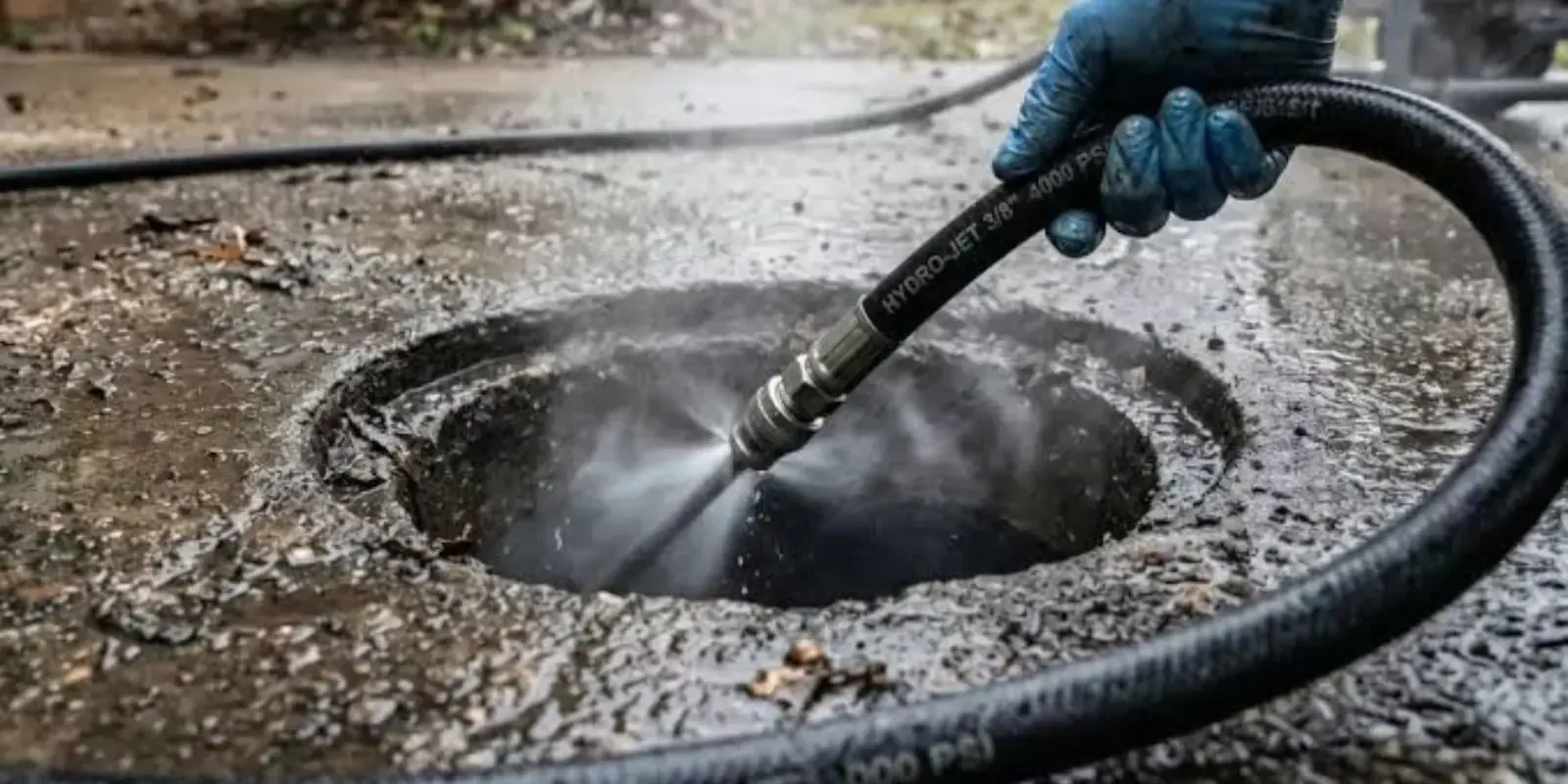
How a hydro jet actually works
A hydro jet is a pump on a truck or cart that sends water through a flexible hose at roughly 1,500 to 4,000 psi. Residential work generally sits at the lower end of that range. The nozzle at the tip has several small jets. Some fire backward to pull the hose forward, and others fire to the sides to scour the pipe wall.
A snake (also called an auger or cable machine) pushes a spinning cutter through the clog. It restores flow fast but leaves a coat of grease and scale on the walls. Jetting washes that coat away. That is the reason a jetted line often stays clear longer, and why hydro jetting is the usual answer for grease that keeps returning.
Jetting or snaking: a quick decision guide
Both tools have a job. The right pick depends on what is blocking the pipe.
| Situation | Better first choice | Why |
|---|---|---|
| A one-time clog from a dropped item or paper wad | Snake | Cheaper and fast. No need to scour the walls. |
| Kitchen line slowed by grease over months | Hydro jet | Water melts and flushes the grease coating the pipe. |
| Tree roots in a sewer lateral | Hydro jet with a root-cutting nozzle, or a cable cutter | Both can open the line. Roots regrow without a repair. |
| Main line that backs up every few months | Camera, then jet | Find out why before paying for repeated cleaning. |
| Cracked, offset, or collapsed pipe | Neither until repaired | Pressure or a cutter can make the damage worse. |
A camera inspection before the work tells you which row you are in.
What a jetting visit looks like
The details change by plumber and by pipe, but the order is usually the same.
- 1
Find the access point
This is typically a cleanout, the capped pipe at the side of the house or in the yard. Without one, a plumber may pull a toilet or use a roof vent.
- 2
Run a camera first
A small camera on a cable shows the grease, roots, or damage. It tells the plumber what pressure and nozzle to use.
- 3
Feed the hose in
The nozzle goes in first, with water running. The pressure pulls it forward and rinses debris back toward the cleanout.
- 4
Make passes
The plumber pulls the hose back slowly, then repeats. Extra passes clear the walls, not just the center.
- 5
Confirm with a final camera look
A second camera run shows clean walls and any damage the clog had been hiding.
Why Mauldin lines grow roots and silt
NWS Greenville-Spartanburg lists a normal annual precipitation of roughly 47 inches. That steady rain keeps the ground moist for most of the year, and tree roots go looking for moisture and nutrients. A sewer lateral joint is a small, damp target. If your yard has mature trees, ask the plumber to look for root growth on the camera.
The USDA's Cecil series description notes red clay soils that are common across the South Carolina Piedmont. Clay holds water and swells and shrinks, which can slowly shift buried pipe. That is a reason to run a camera before you jet, because a shifted joint needs repair rather than another round of water.
Source type: NWS Greenville-Spartanburg precipitation normal and USDA Cecil series description.
Signs your pipes may be ready for a jet
- The same drain slows down again within a few months of snaking.
- A kitchen line gurgles and smells even after a snake pass.
- Several fixtures drain slowly at the same time.
- A camera shows grease or scale lining the wall of the pipe.
- A camera shows roots entering at a joint and the pipe is otherwise sound.
- You are about to buy a house and want to know the sewer line is clear.
Not every slow drain needs jetting. A bathroom sink with a hair clog is a ten-minute snake job.
What hydro jetting typically costs
Typical U.S. prices for a residential hydro jet visit run from about $250 to $800, and larger or harder jobs can cost more. The real number comes from a call and a look at the line, since these factors move it.
Insurance rarely pays for routine drain cleaning, and coverage varies by policy, so ask your carrier. For a price on your drain, call (855) 575-2890.
When hydro jetting is a bad idea
Old clay, cast iron with heavy rust, and Orangeburg (a fiber pipe used in some mid-century homes) can fail under pressure. A cracked pipe can also leak water into the soil around it. That is why a reputable plumber looks first.
If the camera shows a break or a belly full of standing water, the fix is pipe repair or replacement. Talk to a licensed plumber about a sewer camera inspection before agreeing to anything else.
Can you rent a jetter and do it yourself?
Small electric pressure washers with a drain-jet hose sell in home stores, and they work on light clogs in short branch lines. Wear eye protection and gloves. Do not point a jet at your hand or foot.
A full jetting rig for a main line is a different animal. Pumps at 3,000 psi can hurt you, and the hose can whip back out of a cleanout. For a main line, call a plumber and ask for a jetting visit with a camera.
If you live near Mauldin's edges
Plumbers dispatched from Mauldin also work Fountain Inn and Taylors. Ask whether the line you are cleaning runs under a road or an easement, since that affects who must fix a break.
For any city, ask for the camera footage before and after jetting. It is the plain proof of what was in the pipe.
Hydro jetting questions from Mauldin homeowners
It depends on the pipe. Sound PVC and cast iron usually handle it. Cracked clay, heavily rusted iron, and Orangeburg can fail. A camera run first lets the plumber choose pressure or skip jetting.
A short branch line can take under an hour. A long sewer lateral with roots may take several hours with camera passes. Ask for a window when you call.
No. It clears them from the pipe, but if roots enter at a cracked or loose joint they regrow. Root growth often returns in a year or two without a repair.
Only when the line needs it. Some kitchen lines benefit every year or two, while a clean PVC lateral may never need it. Camera findings should drive the schedule.
Light pressure-washer jets can work on short, small lines. A main line needs a professional rig and a camera. Hose whip and high pressure can injure you.
NWS Greenville-Spartanburg lists roughly 47 inches of normal annual rain. Wet ground encourages root growth toward lateral joints, so a Mauldin yard with large trees is a good case for a camera look.
On sound modern pipe, no. The water scours buildup and leaves the pipe walls intact. The risk is in pipes that were already damaged.