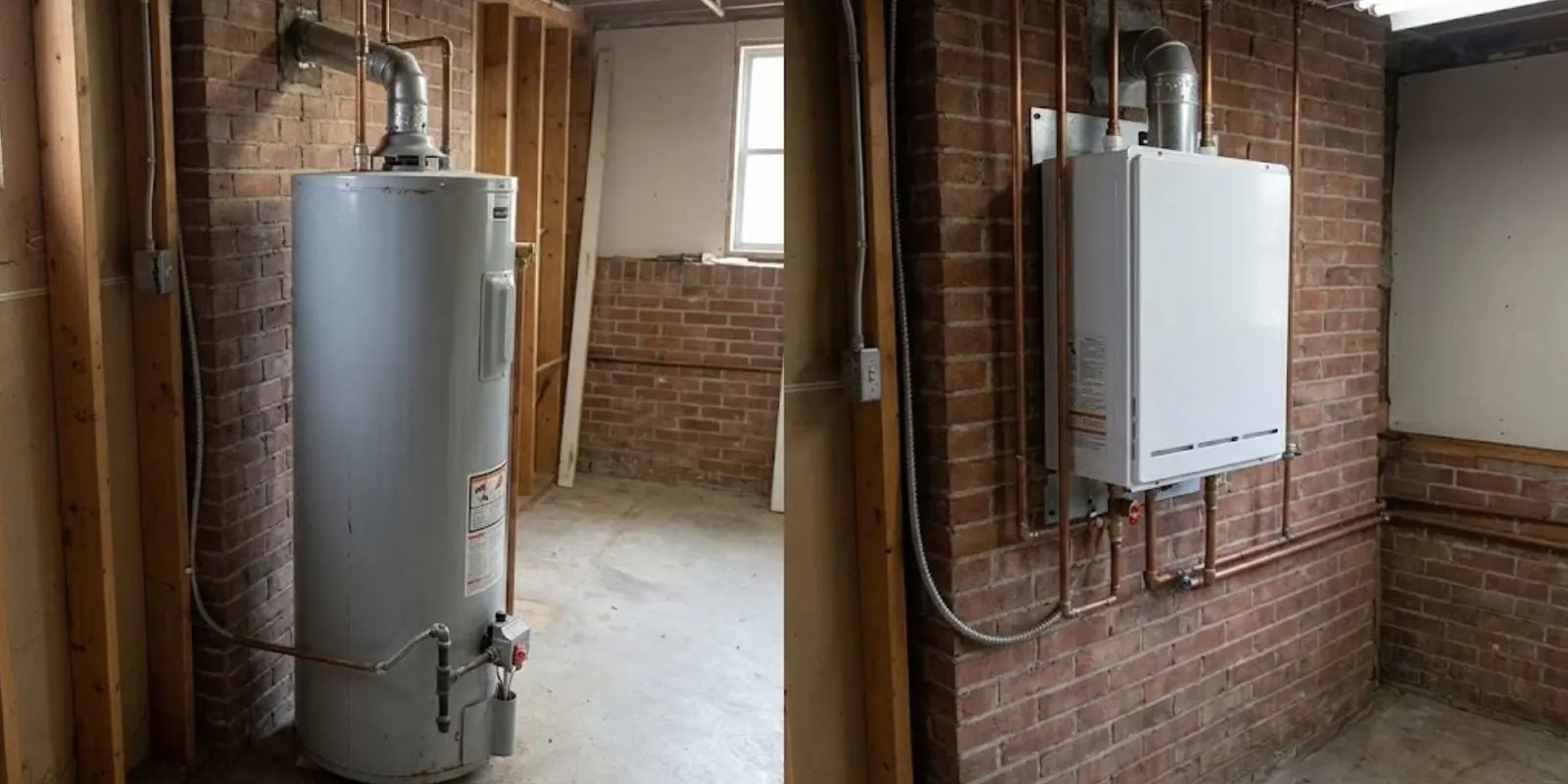
Typical installed cost, by job type
These are typical U.S. ranges, not quotes. The real number depends on your house, your fuel, and the site visit.
| Job | Typical installed range | What drives it |
|---|---|---|
| Gas tankless replacing a gas tank, same location | $2,500 to $4,500 | Existing gas line size and vent path |
| Gas tankless replacing a gas tank, new vent and larger gas line | $3,800 to $6,500 | Vent material, wall penetration, and pipe run |
| Electric tankless, point of use (one bath) | $600 to $1,800 | Small unit, one dedicated circuit |
| Whole-house electric tankless | $2,000 to $5,000 | Several high-amp breakers and possible panel upgrade |
| Moving from electric tank to gas tankless | $4,500 to $8,000 | New gas line, new vent, and relocation |
| Condensing gas tankless with PVC vent | $3,000 to $5,500 | Condensate drain and neutralizer |
Equipment alone commonly runs $600 to $2,000. The rest is labor, parts, and permit.
The unit is only part of the bill
A tankless heater heats water as it flows, so it demands a lot of energy all at once. A gas model can draw 150,000 to 199,000 BTU per hour, much more than a typical 40 gallon tank at 30,000 to 40,000. That demand is why the gas line, vent, or electrical supply so often needs to change.
Sizing the unit also matters. For a fuller treatment of flow rates and temperature rise, a plumber who works on tankless water heaters will ask how many showers and appliances run together.
The line items that move the price
Quotes that look far apart usually differ on these items.
Insurance generally does not pay for planned upgrades, and coverage varies by policy. For a number tied to your home, call (855) 575-2890.
Permits and household facts for Mauldin
The City of Mauldin Building and Zoning office says a permit is required before you add, alter, or replace any plumbing system. Contractors must be licensed, bonded, and insured and have the permit before starting. The office sits at 5 E. Butler Rd and can be reached at (864) 234-3475.
That means a quote that skips the permit is a warning sign. A tankless install changes gas, vent, and water connections, so the permit belongs in the price from the start.
Census figures list Mauldin at 68.0 percent owner-occupied homes with a median owner-occupied value of $258,500 and 2.30 persons per household. A smaller household often needs a smaller unit than a house of five. A $4,000 to $6,000 install is also a real share of that median value, so ask for a payback estimate rather than a sales pitch.
Source type: City of Mauldin Building and Zoning page and U.S. Census QuickFacts.
How to compare tankless quotes
- 1
Give every plumber the same facts
Share fuel type, current heater location, number of bathrooms, and how many fixtures run at once.
- 2
Ask what is in the price
Unit model, vent material, gas pipe size, electrical work, permit, haul-away, and flush valves.
- 3
Confirm the permit
Ask who pulls it and whether the plumber is licensed, bonded, and insured as Mauldin Building and Zoning requires.
- 4
Ask about the gas and vent plan
A written plan with pipe sizes beats a verbal yes.
- 5
Compare payback honestly
Tankless units often last about 20 years versus 10 to 12 for a tank. Energy savings depend on use, so ask for assumptions.
Running costs after the install
A tankless unit has no tank to keep hot, so it avoids standby loss. Gas models burn fuel only while water flows. Electric models draw heavy current for short bursts, which can raise the demand on your panel.
Plan for a yearly flush with vinegar or a descaling solution run through the isolation valves. A flush takes about an hour and clears mineral sediment from the heat exchanger. A neglected unit loses efficiency and can throw error codes. Budget about $100 to $200 for a plumber to do it, or less if you do it yourself on a unit with service valves.
When a tank replacement makes more sense
If the gas line is undersized, the vent path is hard, and the budget is tight, a new tank may be the better call. A tank swap often costs far less than a tankless conversion. A plumber who handles water heater replacement can price both side by side.
Tankless units are a good fit for homes that want endless hot water and steady use. For occasional use, the extra cost may not repay.
Questions to ask before you sign
- Is my gas meter and line large enough for this unit?
- Is the vent pipe stainless or PVC, and where does it exit?
- Does my panel have room for the circuit the unit needs?
- Who pulls the permit, and will an inspection follow?
- What is the first year flush schedule, and are isolation valves included?
- What does the warranty cover for labor, not only parts?
If you live in nearby towns, the same questions apply. Our dispatch also serves Greer and Simpsonville, where permit rules may differ.
Tankless cost questions from Mauldin homeowners
The unit costs more, and the house often needs changes. A larger gas line, new vent pipe, and electrical work are the usual reasons.
Not safely for gas units, and the local permit rule still applies. Gas and vent errors can cause leaks and carbon monoxide. Ask the Mauldin Building and Zoning office what a homeowner may do.
Often, yes. Tankless gas units use far more BTU per hour than a tank. A plumber measures the existing line, run length, and meter capacity.
The Building and Zoning office says a permit is required, but this page does not list a fee, so ask. Call (864) 234-3475 or check the city's permit page for the current schedule.
A simple swap can take half a day. A job with a new vent, gas line, or panel work can take a day or more.
Not always. Census data show 2.30 persons per household in Mauldin, but the right size depends on simultaneous fixtures and incoming water temperature, not only headcount.
Often, but not always. Savings depend on how much hot water you use, your fuel price, and the installation cost. Ask for assumptions in writing.