Emergency steps when water is pouring into your business after hours
Commercial calls at night differ from home calls. There is stock on the floor, a landlord to reach and sometimes a tenant next door sharing the same line. Work through these moves while the dispatcher gets a plumber moving.
Close the main
The building shutoff is usually where the water line enters, in a utility room or a meter box. Turn it clockwise until it stops.
Cut power to wet areas
Flip the breaker for wet rooms only if you can reach the panel dry. Never step into standing water near outlets.
Protect stock and records
Lift boxes and paper off the floor. Move cash registers, computers and food stock out of the spread.
Call with the facts
Give the building type, what is leaking or backing up, whether the main is shut and who can meet the plumber on site.
Smell gas? Leave the building and call the gas utility or 911 before you call a plumber.
Common commercial plumbing trouble by building type
| Property | Typical trouble | First check |
|---|---|---|
| Restaurant or cafe | Grease-clogged drains and backing floor drains | Look at the grease trap and the floor drain nearest the kitchen |
| Retail shop or office | Leaking restroom supply lines and running toilets | Read the water meter with every fixture off |
| Multifamily building | One stack backing up into several units | Ask which floors are affected, then see main line cleaning |
| Warehouse or light industrial unit | Floor drain overflow and restroom group leaks | Check cleanouts and the lowest drain first |
Hidden leaks that run all night in a commercial building
Commercial leak detection is the biggest reason property managers call outside emergencies. The cheapest test is a meter reading at close and again at open. If the meter moved overnight in an empty building, water is escaping somewhere.
The line leaving the water meter is the customer's to maintain. Greenville Water maintains the line up to the outlet side of the meter, so a leak between meter and building is the owner's repair. Closing valves zone by zone shows which section holds pressure.
Then the plumber narrows it with acoustic listening, a thermal camera for hot lines in floors and a pressure test on the isolated section. See finding a hidden leak for the full method. Evening and weekend visits help, since quiet buildings make faint leaks easier to hear.
Annual backflow testing if your building is on Greenville Water
Backflow is water moving backward from a building into the public supply, which can carry contamination from a boiler, irrigation system or fire line. Greenville Water runs a service-wide Cross Connection Control Program and requires customers whose water presents a backflow hazard to install a device or assembly.
- 1
Find the assembly
Look near the meter, fire line or irrigation tie-in. A reduced pressure assembly has two shutoffs and a relief valve.
- 2
Hire a certified tester
Devices must be tested annually per SCDES and Greenville Water standards. Greenville Water does not install or test them, so the owner books it. Ask the dispatcher if a certified tester can be scheduled.
- 3
Test and report
The tester checks the check valves and relief valve, then submits results through the utility portal. Keep your copy.
- 4
Repair and retest
A failed assembly is rebuilt or replaced, then tested again before the report is filed.
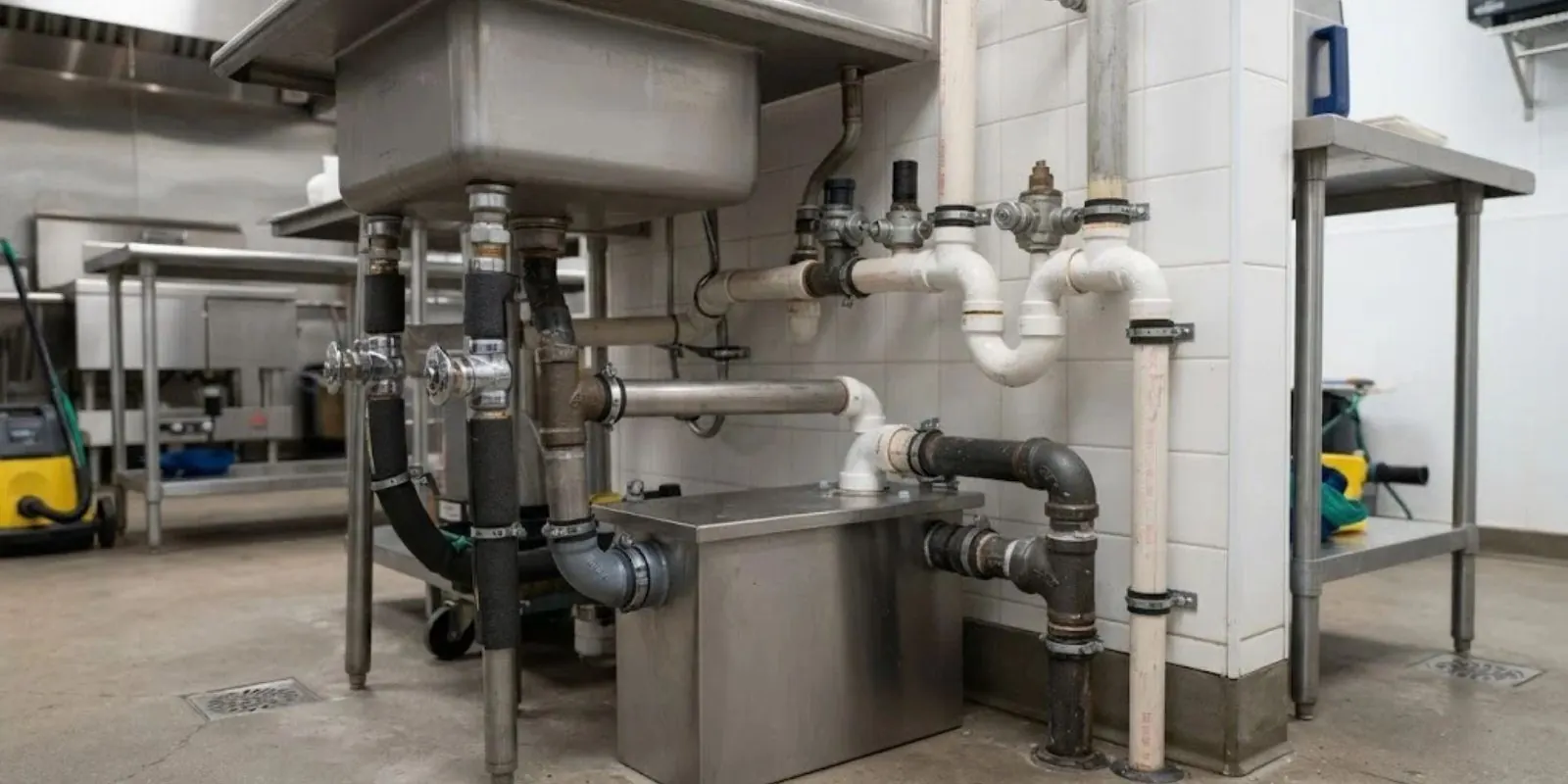
Grease trap trouble in a commercial kitchen
A grease trap slows kitchen wastewater so fat floats up and solids settle before reaching the sewer. When it fills, fat passes through and hardens in the building drain, usually during the dinner rush.
- Floor drains drain slowly or gurgle after the dishwasher runs.
- A sour smell rises near the three-compartment sink or the trap lid.
- Grease shows up at the cleanout or in the first manhole outside.
- The trap lid is hard to lift because of a thick fat cap.
Cleaning removes the fat cap, water and settled solids and scrapes the baffles. A common rule is to clean when fat and solids reach about a quarter of the liquid depth. Ask the City of Mauldin Public Works Sewer Division at (864) 289-8904 whether any schedule applies to your kitchen.
If the line past the trap is already coated, hydro jetting clears it. Non-urgent trap cleaning can often be booked same-day when available.
Commercial buildings in Mauldin and what their age means
Mauldin's commercial buildings span decades. Brookfield Business Park opened in 1988, City Hall was built in 2000 and the Mauldin Sports Center on City Center Drive opened in 2007. The Cultural Center is the former 1937 Mauldin School. A 1930s building and a 2000s building rarely share pipe materials, so an older one deserves a camera look before big work.
BridgeWay Station sits at the I-385 Bridges Road exit with a Simpsonville address, right next to Mauldin. If your address is in that area, confirm which city's permit office covers it. Our Simpsonville coverage uses the same dispatch.
Licensing differs by size. Commercial plumbing work over $10,000 falls under the SC Contractors' Licensing Board. Permit rules vary, so ask the Mauldin Building and Zoning office before a larger job.
Source type: City of Mauldin history, SC LLR, Greenville Water program page.
What drives commercial plumbing cost
Typical U.S. ranges: a commercial drain clearing about $200 to $600, a grease trap cleaning about $200 to $600, and a backflow test about $75 to $200 per assembly. After-hours and holiday calls often cost more than daytime visits. Your real number comes from a call.
Insurance for a sudden burst varies by policy, so ask your carrier early. Call (855) 575-2890 for a clear price before work starts.
Commercial plumbing questions from Mauldin businesses
Yes. The dispatch line at (855) 575-2890 is open around the clock, including holidays. Have the building address, what is leaking or backing up, whether the main is shut and a contact on site. Timing depends on that night's call volume, and the dispatcher explains it on the call.
Usually yes. A meter test, acoustic listening, a thermal camera and section pressure tests point to the spot first. Walls are opened only at the confirmed location.
If Greenville Water has required a device on your connection, it must be tested annually. Ask the utility, whose customer service is (864) 241-6000, whether your account has a device on file.
A common rule is when fat and solids reach about a quarter of the liquid depth, which can mean monthly for a busy kitchen. Local rules may set a schedule, so ask Public Works.
That depends on the lease. Read it, call the property manager, and do not delay the emergency shutoff while you sort it out.
A plumber can jet private on-site drain lines and clear a catch basin on your property. Public storm drains generally belong to the city, county or state, so ask which owns the one on your street. The dispatcher can confirm what fits your site.