The short answer before the gadgets
A plumber does not find most hidden leaks by guessing where to dig. The job starts by narrowing the leak to a zone, then uses a tool matched to the pipe material and the location. Four methods cover nearly every case: acoustic listening, tracer gas, thermal imaging and pressure testing.
Each one answers a different question. Pressure testing says whether a leak exists on a run of pipe. Listening and gas say where. Thermal imaging says which part of a wall or floor carries warm water. The best visits combine two, because any single method can mislead.
If you are weighing a call, the rule of thumb is simple. A wet spot you can see is a repair job. A bill that jumped with no visible cause, or running water you hear with every tap closed, is a job for professional leak detection. Most Mauldin homeowners land in the second group.
Four methods side by side
Here is what each method detects, where it works best and where it struggles.
| Method | What it picks up | Works best on | Weak spot |
|---|---|---|---|
| Acoustic listening | The hiss or hum of water escaping a pressurized pipe | Metal lines, exposed pipe, slab floors, the line from the meter | Plastic pipe carries sound poorly, and traffic or appliances add noise |
| Tracer gas | Hydrogen blend escaping upward through soil, slab or wall | Hard-to-hear leaks, plastic pipe, leaks under concrete | The line must be drained and filled with gas, so it takes more setup |
| Thermal imaging | Temperature differences from warm or cold water in a surface | Hot-water leaks, radiant lines, wet drywall and ceilings | Shows a temperature pattern, not the exact pipe joint |
| Pressure testing | A pressure drop on an isolated section of pipe | Confirming a leak exists and which line has it | Gives no location, only yes or no for that section |
Typical practice, not a guarantee. A plumber picks the mix after asking about symptoms.
Acoustic listening, in plain terms
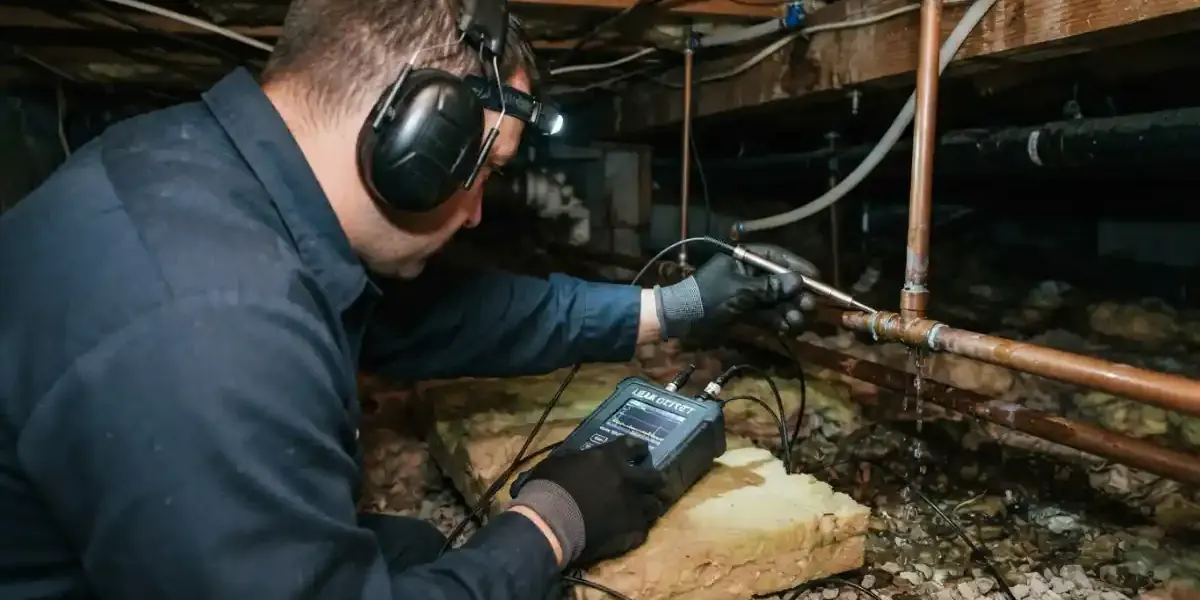
A leaking pressurized pipe makes a faint hiss, or a low rumble if the leak is large. A ground microphone or a contact sensor on a valve picks it up, and a handheld amplifier lets the plumber hear it through headphones.
The technician walks the suspected line and listens at intervals. The sound is loudest directly above the break, so the readings form a map that narrows to a few feet. It works well on copper and galvanized steel. Plastic pipe such as PEX and PVC dampens the sound, which is why a second method often backs it up.
Tracer gas when the sound is not enough
Tracer gas is a harmless mix of about 5 percent hydrogen and 95 percent nitrogen. The plumber isolates a section of pipe, drains it, then fills it with the gas. Hydrogen is the lightest molecule there is, so it rises quickly through soil, slab and drywall.
A sniffer probe at the surface reads the gas, and the highest reading sits above the leak. It is the method of choice when the leak is too quiet to hear or the pipe is plastic. The cost is time, because the line must be drained first.
Thermal imaging and what it can and cannot show
An infrared camera turns surface temperatures into a color picture. A hot-water line leaking inside a wall or under a floor warms the surface above it, and the camera sees the warm patch. Cold-water leaks show as cooler, damp areas that dry slower than the surrounding material.
The camera sees the surface only. It cannot see through a wall to a pipe, and it reads a damp towel or a sunny window as readily as a leak. A good operator uses the image to choose where to listen or test next, not to cut a hole on its own.
How a detection visit usually runs
The order matters, because each stage rules something out cheaply before the next one starts.
- 1
Confirm the leak is real
Close every fixture, read the meter, wait 15 minutes, then read it again. If it moved, the leak is real and the visit goes ahead.
- 2
Split the system
Shut the house cutoff. If the meter still moves, the leak is outside before the house. If it stops, the leak is inside.
- 3
Pressure test the section
The plumber isolates the cold side, hot side or the yard line and watches a gauge for a drop.
- 4
Pinpoint with listening, gas or heat
The tool is chosen by pipe material and location. Marks go on the floor or ground at the strongest reading.
- 5
Open the smallest hole that works
Repair starts at the mark, not across the whole room. A good pinpoint can mean a hole the size of a dinner plate.
What Greenville Water's meter rule means for Mauldin owners
Greenville Water maintains the line up to the outlet side of the meter. According to its customer service page, the line leaving the meter is the customer's service line and the customer's responsibility. So a leak between the meter and your house is yours to find and fix, even though the pipe sits in the yard.
That makes the meter the first free detection tool you own. Greenville Water's check is to read the meter, wait at least 15 minutes with no water in use, and see if it moved. If you shut the house cutoff and an outdoor meter still runs, the leak is on the buried stretch, and a plumber brings listening gear to the yard.
One more local detail helps avoid false alarms. Greenville Water treats its supply with chloramine, a chlorine and ammonia blend. A worn toilet flapper can leak silently into the bowl, so run Greenville Water's dye test first: food coloring in the tank, no flush, and a look at the bowl after an hour.
Source type: Greenville Water customer service page and Consumer Confidence Report.
Signs electronic detection is worth paying for
Any one of these is a reason to call. Two or more is a strong case.
- The meter moves with every fixture closed.
- A water bill climbs with no change in how many people live in the home.
- You hear running or hissing water in a quiet house.
- A floor feels warm in one spot, with no radiant heat installed.
- A wall or ceiling stain keeps coming back after a patch.
- Water pressure drops without a clear cause.
If you see actively gushing water, skip the diagnosis. Shut off the main and call the 24/7 line.
What to do yourself and what to hand off
Homeowners can handle the meter check, the toilet dye test, the spigot check and a quiet walk-through. Those cost nothing and clear many calls. Photograph the meter dial before and after so the result is clear.
Tracer gas, a ground microphone or a pressure rig is a plumber's job, and so is opening a slab or wall. A wrong cut costs more than the detection fee. When the leak sits on the yard line, a plumber can explain repairing the buried water service line once it is located.
Questions to ask before you book
Ask which methods the plumber plans to use and why. A thermal camera alone for a buried line is a red flag. Ask whether the price covers pinpointing only or the repair too.
Ask how the quote changes if the first method finds nothing. The same kinds of hidden leaks turn up in Greenville and Greer, so a good answer sounds the same everywhere.
Leak detection questions from Mauldin homeowners
No. Listening, thermal imaging and pressure testing are all non-invasive. Tracer gas also stays inside the pipe and reads at the surface. Damage only happens when the plumber opens the pinpointed spot to repair the pipe, and that hole is kept as small as possible.
On metal pipe it can narrow a leak to a few feet. On plastic pipe the sound is weaker, so many plumbers confirm with tracer gas before cutting concrete. Expect the plumber to mark the spot and explain how confident the reading is.
Yes. Shut the house cutoff and watch the meter. If it keeps running, the leak is between the meter and the house. If it stops, the leak is in the house plumbing. Greenville Water publishes this same check on its customer service page.
The mix is mostly nitrogen with a small share of hydrogen, and it is used in tiny volumes inside a drained pipe. It is not a fuel gas. If you ever smell natural gas, leave the home and call the gas utility or 911 before you call a plumber.
Rarely. It shows temperature patterns on a surface, and a window, a damp towel or sunlight can fake a leak. It is a good first screen for hot-water leaks, but pinpointing normally needs a second method.
The homeowner. Greenville Water maintains the line up to the outlet side of the meter, and the customer maintains the line leaving it. A plumber hired by you handles that stretch.
Yes. Greenville Water uses chloramine, and an old flapper can leak quietly for months. A dye test takes an hour and costs a few drops of food coloring, which is far cheaper than a detection visit.