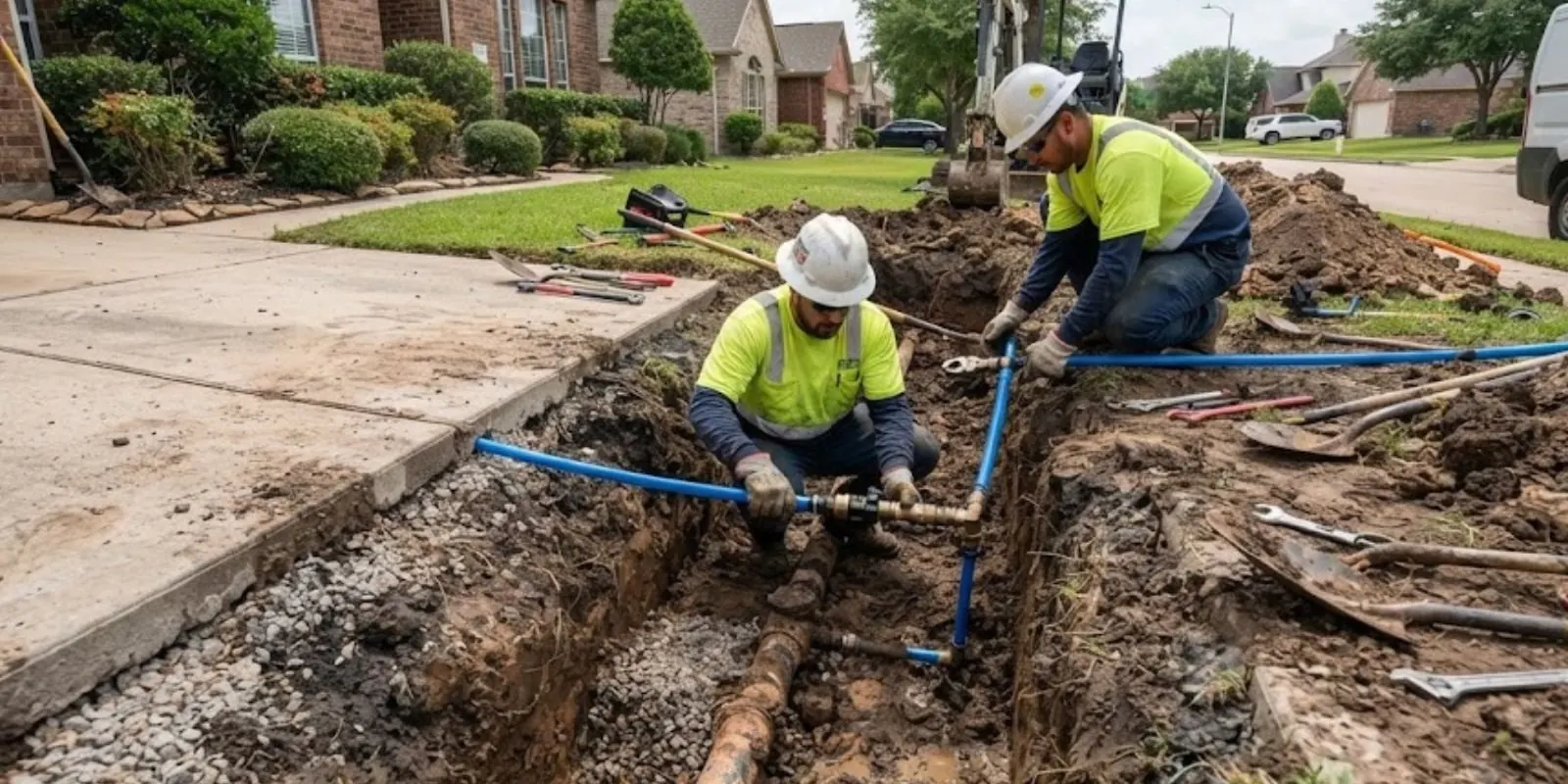
You own the pipe once it leaves the meter
Greenville Water maintains the line up to the outlet side of the meter. Greenville Water states that the line leaving the meter is the customer's service line, and the customer maintains it. A wet patch past the meter is therefore your repair, not a utility call.
That ownership line matters when you are deciding fast. If the meter box itself is leaking before the shutoff, call Greenville Water at (864) 241-6000. If water rises anywhere beyond it, a plumber is the right call.
Confirm a buried leak in four checks
These checks come from Greenville Water's own guidance and take about half an hour.
- 1
Stop all water use
Close taps, check that no toilet is running and make sure the ice maker and irrigation are idle.
- 2
Read the meter
Note the dial, wait at least 15 minutes with no water used, then read it again.
- 3
Close the house cutoff
Shut the main valve at the house and watch the outdoor meter.
- 4
Read the result
If the meter still runs with the house cutoff closed, the leak is in the line between meter and house.
The line has burst and water is surfacing
A pressurized 3/4 inch or 1 inch line can move a lot of water through a small crack, much like a burst pipe inside the house. Treat a fast-growing wet spot as urgent.
Close the main shutoff
Turn it off inside the house. This stops flow to everything downstream of the break.
Keep clear of the spot
Saturated clay can slump, and water can undermine a driveway edge or a walk.
Do not run a hose to flush it
Adding water makes the washout larger and hides the source.
Fill a few containers first
Store water for drinking and toilets before the main goes off for repair.
Call (855) 575-2890. After-hours and weekend calls go to the same dispatch, and a same-day visit is offered when a plumber is open.
Repair, replace or reroute the line
The right choice depends on pipe material, length and how many breaks the line has had.
| Option | Best for | Trade-off |
|---|---|---|
| Spot repair with a coupling | One clean break in sound pipe | Cheap and quick, but the next weak point may be a few feet away |
| Trench and replace the run | Old galvanized or repeated leaks | Digs up lawn and paving, yet it ends the problem for decades |
| Trenchless pipe pulling | Lines under driveways, walks or roots | Needs entry and exit pits and suitable soil |
| Reroute a new line | Lines that run under a slab or addition | Costs more and changes the meter-to-house path |
Do not choose replacement for one pinhole in a new copper or PEX line. A coupling is the honest repair.
How an older Mauldin line fails
Greenville Water lines reached Laurens Road in 1953, and US 276 was built through the center of Mauldin in 1956. Homes here went up over several decades, so service lines are a mix of materials: galvanized steel, copper, polyethylene and PVC. Galvanized pipe rusts from the inside and loses flow long before it leaks.
So ask what the line is made of. If the whole house has old galvanized pipe, a repipe of the house plumbing may belong on the same quote. A plumber who traces the pipe at the meter can tell, and the answer decides whether a patch holds. Red clay soils are common across the SC Piedmont, and clay holds water against a leak and hides its path to the surface.
Signs the buried line is leaking
- The meter dial moves with every fixture off.
- A section of lawn stays soggy in dry weather.
- Water pressure drops through the whole house at once.
- You hear a hiss near the entry wall or the meter.
- The monthly bill climbs with no change in habits.
Any one of these deserves the meter test. Two or more together call for a pinpoint leak survey before anyone digs.
What changes water service line repair cost
Typical U.S. costs run roughly $500 to $1,500 for a short spot repair and $1,500 to $5,000 or more to replace a line. The real number depends on the job and comes from a call.
Ask your insurer whether the line is covered, since policies differ. A broken line is also grounds to check slab leak repair if pipes run under the floor.
Permits for a Mauldin service line job
The City of Mauldin says a permit is required before you add, alter or replace any plumbing system. Contractors must be licensed, bonded and insured, and have the permit before starting. Ask the Building and Zoning office at 5 E. Butler Rd, (864) 234-3475, whether your line work needs one.
That is why an unpermitted dig by a handyman is a risk. Hiring a licensed plumber also gives you a person to call if the repair fails.
Source type: City of Mauldin Building and Zoning permit page.
Service line questions from Mauldin homeowners
Yes. Dispatch is open 24/7, and same-day or after-hours visits are offered when a plumber is available. No arrival time is promised. The dispatcher will tell you how to shut the water off and what to do next.
Under Greenville Water's published rule, the customer maintains the line leaving the meter. Check your homeowner policy for coverage details.
Close the house cutoff and watch the outdoor meter. If it still runs, the leak is outside, between the meter and the house.
Often yes. Listening equipment and pressure tests narrow the spot to a few feet, so the dig is small.
Yes, while the broken section is open. The plumber will tell you how long, and you can fill containers beforehand. Neighbors in Greenville and Mauldin call the same line.
No. They maintain the line up to the meter. For the pipe leaving the meter, call a plumber.
It depends on the pipe. In galvanized steel with several rust spots, yes. In newer copper with one failed joint, a repair is usually enough.