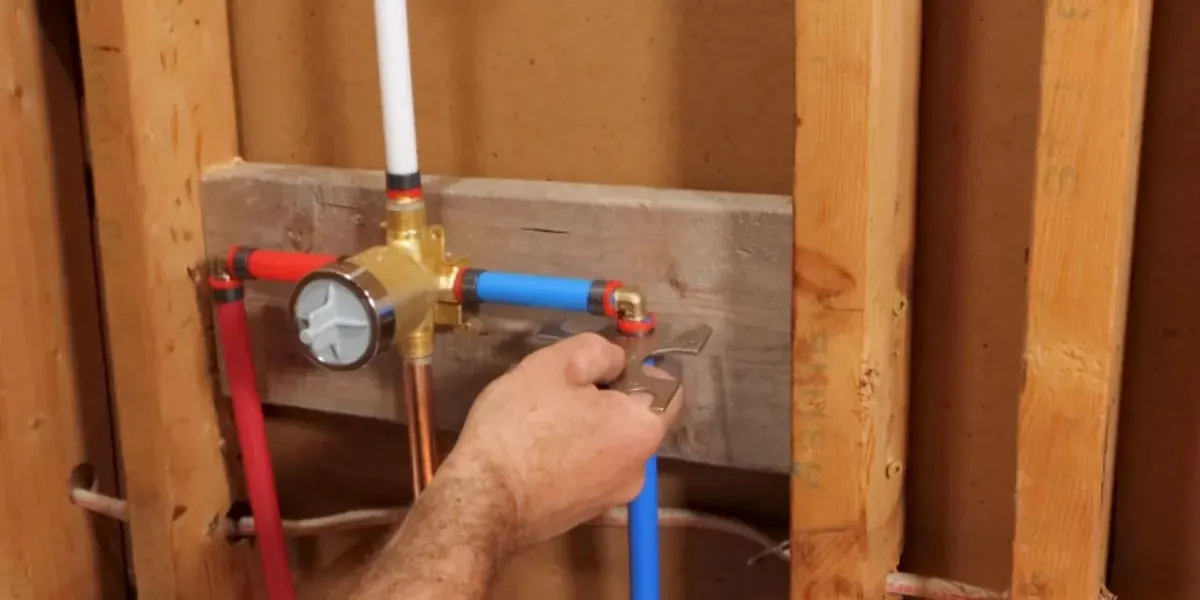
What a rough-in covers and what it does not
Rough-in means everything a plumber installs before the finish work, the kind of job covered under new plumbing installation. That is the 2-inch drain and trap, the vent that lets the drain breathe, the half-inch hot and cold supply lines, and the mixing valve body set at the right depth in the wall. It does not include the trim kit, the showerhead, the tile or the glass.
Think of it as the skeleton. Once the wall is covered, you can only reach it by cutting into it. That is why most of your decisions about a shower, including where the drain sits and how high the head hangs, are really made at this stage.
Measurements to confirm before the walls close
These are common targets, not a substitute for your fixture's installation sheet. Valve and drain manufacturers publish exact depths, so keep the paperwork for your plumber.
| Item | Typical target | Why it matters |
|---|---|---|
| Drain and trap | 2 inches, with a P-trap | Most plumbing codes call for 2 inches on a shower. A smaller pipe backs up faster. |
| Drain slope | 1/4 inch per foot | Too flat and the line holds water and debris. Too steep can leave solids behind. |
| Valve height | Often 38 to 48 inches off the floor | You should be able to start the water without standing in the spray. |
| Showerhead arm | Roughly 72 to 84 inches | Tall users and rain heads need the high end of the range. |
| Supply pipe | 1/2 inch hot and cold | Undersized lines starve a multi-head setup. |
| Blocking | Solid wood or metal behind the valve and any grab bar | Screws need something solid to bite into years from now. |
Check your valve manufacturer's rough-in depth. Tile thickness changes where the trim needs to sit.
How a rough-in usually runs, start to finish
- 1
Open the wall and floor
Demo exposes the old drain, the studs and the supply lines. This is when hidden rot or old leaks show up.
- 2
Set the drain and vent
The plumber sets the trap and connects it to the branch line with the right slope. On a slab, that can mean cutting concrete.
- 3
Run supplies and mount the valve
Hot and cold lines tie into the valve body, which is fixed to blocking at the depth the manufacturer lists.
- 4
Pressure test the lines
Caps go on, the lines are filled with air or water, and a gauge should hold steady. A slow drop means a bad joint.
- 5
Schedule the inspection
Where a permit applies, the inspector looks at the rough-in while it is still open.
- 6
Flood test the pan
Before tile, the shower pan or liner is filled and left for a day. A dropping water level means a leak that tile would have hidden.
Permits and codes for a shower rough-in in Mauldin
The City of Mauldin Building and Zoning office says a permit is required before you add, alter or replace any plumbing system. Moving a shower drain or adding a valve counts as altering plumbing. The city also says contractors must be licensed, bonded and insured and must have the permit in hand before starting.
On codes, South Carolina adopted the 2021 SC Plumbing Code, or the 2021 International Plumbing Code with state modifications, and local enforcement has been required since January 1, 2023. The 2024 SC codes are scheduled to take effect January 1, 2027. If your project may run across that date, ask the Mauldin Building and Zoning office which edition applies to your permit.
Source type: City of Mauldin Building and Zoning page and SC LLR Building Codes Council.
Why the drain location drives the budget
Keeping the shower where the old one was is the cheap path, because the drain and vent are already there. Moving it a few feet in a house with a crawlspace is usually manageable. Moving it on a concrete slab means cutting the floor, trenching, and patching.
Typical U.S. plumbing-only costs for a rough-in run from about $800 to $3,000, and a slab relocation can push past that. The real number depends on access, the distance to the branch line and what the open wall reveals. A call and a look at the space is the only way to get a firm figure.
Before you call a plumber for a rough-in
A short list of decisions makes the visit faster and the quote clearer.
- Pick the fixture first, since valve depth and drain size come from its paperwork.
- Decide on the showerhead style, including any rain head or handheld.
- Note whether the floor is a slab, a crawlspace or an upper level.
- Photograph the existing drain location and nearby walls.
- Ask whether your tile or surround needs extra wall depth for the valve.
- Confirm who will pull the permit and schedule the inspection.
The flood test most people skip
A pan that leaks slowly will not show anything for months. Then a stain appears on the ceiling below, or the subfloor softens. A 24-hour flood test costs a few gallons of water and one day. If you need to trace a leak later, a plumber can use leak detection equipment, but finding it before tile is far cheaper.
DIY or plumber: where the line is
Swapping a showerhead, trim kit or cartridge is a fair DIY job. Soldering or crimping new supply lines, setting a drain at the right slope and passing an inspection is not, especially because Mauldin requires a licensed, bonded and insured contractor to pull the permit.
If you are determined to do the carpentry, such as framing and blocking, a plumber can still do the rough-in in a short visit. Splitting the work this way is a fair request, and the same dispatch line serves Simpsonville and Greenville as well as Mauldin.
Shower rough-in questions from Mauldin homeowners
Building and Zoning at 5 E. Butler Rd, Mauldin, SC 29662, phone (864) 234-3475. The city says a permit is required before you add, alter or replace any plumbing system, and applications can be submitted through the city portal.
Sometimes. If the valve is a common brand with a cartridge you can still buy, a plumber can often keep it. Old valves with corroded bodies or no replacement parts are better replaced while the wall is open.
A like-for-like swap on an open wall often takes part of a day. Moving a drain on a slab takes longer because of the concrete work. The pressure test and inspection add scheduling time.
Every fixture drain needs venting so it can drain without gurgling or siphoning the trap. The vent may tie into an existing line nearby, depending on the layout and the plumbing code.
Rough-in is the hidden work done before walls close. Finish plumbing is the visible part, such as trim, showerhead, handles and the final leak check once everything is installed.
That is common in older homes and it is the best time to find them. Repair the damaged section, dry the framing, and pressure test again before closing the wall.