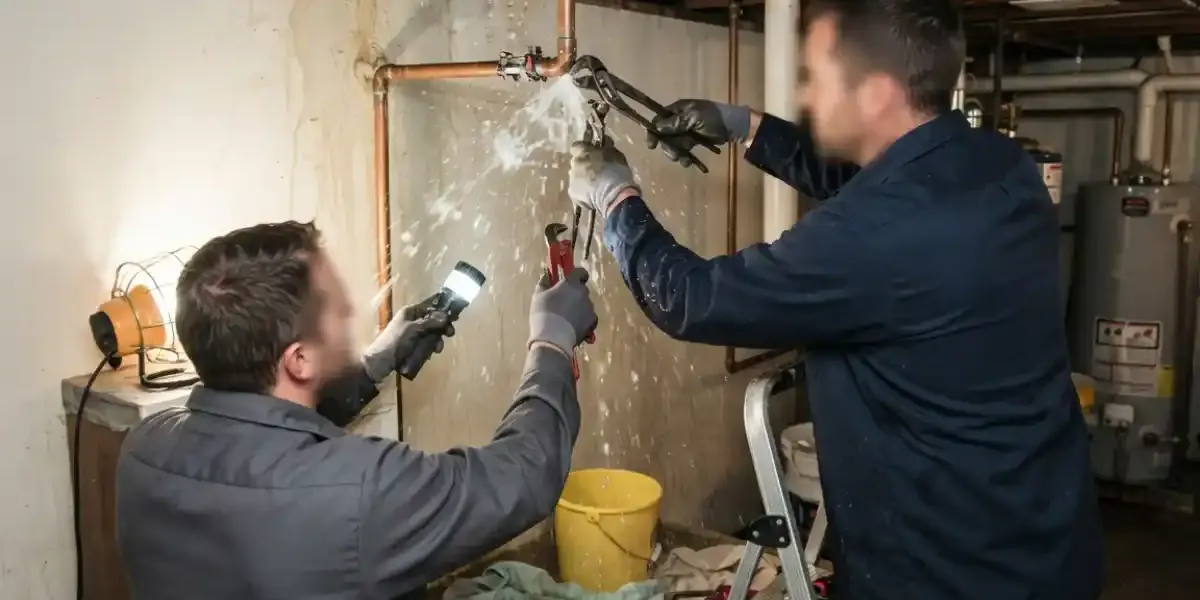
Water gushing right now: the first ten minutes
Do these in this order. They cut the damage while the plumber is on the way.
- 1
Close the main shutoff
Look where the line enters the house, in the garage, crawlspace, basement or a yard box. Turn the handle clockwise until it stops.
- 2
Drain the lines
Open the lowest faucet, then one upstairs. Pressure bleeds off and the flow slows.
- 3
Kill power to wet areas
Flip the breakers for rooms with standing water. Do not step into a flooded room with outlets live.
- 4
Switch off the water heater
An empty tank can burn out an element. Turn off the gas control or breaker.
- 5
Photograph and mop up
Take pictures for your insurer, then lift rugs and run towels. Wet drywall starts to sag within a day.
Why pipes split in a mild climate like ours
NWS Greenville-Spartanburg lists an average January low of 32.1 F and 16 days at or below 32 F. That is enough for ice to form in an exposed line in a garage, an attic or an outside wall. Ice does not burst the pipe where it forms. Pressure builds between the ice plug and a closed faucet, and the split opens in the pipe wall.
Freezing is not the only cause. Old fittings corrode, supply valves under sinks seize and snap when turned, and water pressure above about 80 psi strains joints. Ask the plumber to check pressure after any burst.
What the January 2018 cold spell tells a Mauldin homeowner
On January 3 and 4, 2018, a cold spell broke water mains in Greenville (Academy Street and West Washington Street) and in Greer (Pelham Road and East James Street). In Greer more than 100 homes lost water for a time and a boil water advisory lasted several hours. WSPA's report does not mention Mauldin.
Those were utility mains, not house pipes. The lesson is practical: if your whole street loses pressure, call your water utility. If water is pouring inside your walls while neighbors are fine, the break is on your side, and it is your repair.
Source type: WSPA news report, January 4, 2018.
Pipe material and what repair looks like
The repair method depends on what is in your walls.
| Pipe | Typical repair | Trade-off |
|---|---|---|
| Copper | Cut out the split and sweat in a new section | Solid fix, but fire risk near wood means careful prep |
| PEX | Cut and join with crimp or expansion fittings | Fast, and PEX tolerates some freezing better than rigid pipe |
| CPVC | Cut and couple, often with push-fit | Older CPVC turns brittle and may crack again nearby |
| Galvanized steel | Replace the section or plan a repipe | Rust inside means the next leak is likely soon |
| Supply valve or stop | Replace the valve and braided line | Cheapest fix of the five, and it ends that failure point |
After the water is off: what to check before the plumber arrives
- Find the break or the wettest spot and note its location.
- Check ceilings under the area for bulges and sag.
- Note whether the water hammered or squealed before it failed.
- Check other exposed lines in the garage or attic for ice.
- List wet rooms for your insurance claim.
If a ceiling holds a bulge of water, poke a small hole and catch it in a bucket, since a controlled drain beats a sudden collapse. A leak detection visit is the next step when a stain appears where no pipe is visible.
Repair a section or redo the line
One burst in an otherwise sound line calls for a section repair. That is the right choice for newer PEX or copper that failed because of a freeze or a bad fitting. Skip a full replacement there, because it costs far more than the problem warrants.
Two splits in one season are a different story. They point to corroded pipe or high pressure, and a longer-term plan saves repeat flooding. Ask for both options in writing before work starts.
What drives the cost of a burst pipe repair
Typical U.S. repairs for one accessible split run about $150 to $1,000. Opening walls or floors and drying them are separate costs. The real number comes from a call.
Insurance coverage for burst pipes varies by policy, so ask your carrier what it pays before and after the repair. Call (855) 575-2890 for a clear price before work starts, with same-day visits when a slot is open.
Burst pipe questions from Mauldin homeowners
Yes. The line at (855) 575-2890 is staffed at all hours, and a pipe that lets go at 2 a.m. is treated as urgent. No arrival time is promised, but you get a clear answer on same-day availability and what to do until then.
Look where the water line enters the house: a garage wall, basement, crawlspace or a box in the yard near the street. Find it before you ever need it.
It works the same way. Close the main, then replace the valve and the braided line. It is a short repair, often cheaper than a pipe section.
No. Thaw it slowly with a hair dryer, open the faucet, and never use an open flame. Once it thaws, check for leaks along its length.
Permit rules vary, so ask the Mauldin Building and Zoning office at (864) 234-3475. A repair that alters the system may need one.
Usually no. One failure in sound pipe is a section repair. Repeated failures or rusty water point to a repipe.
Yes. The same line covers Simpsonville and nearby towns.