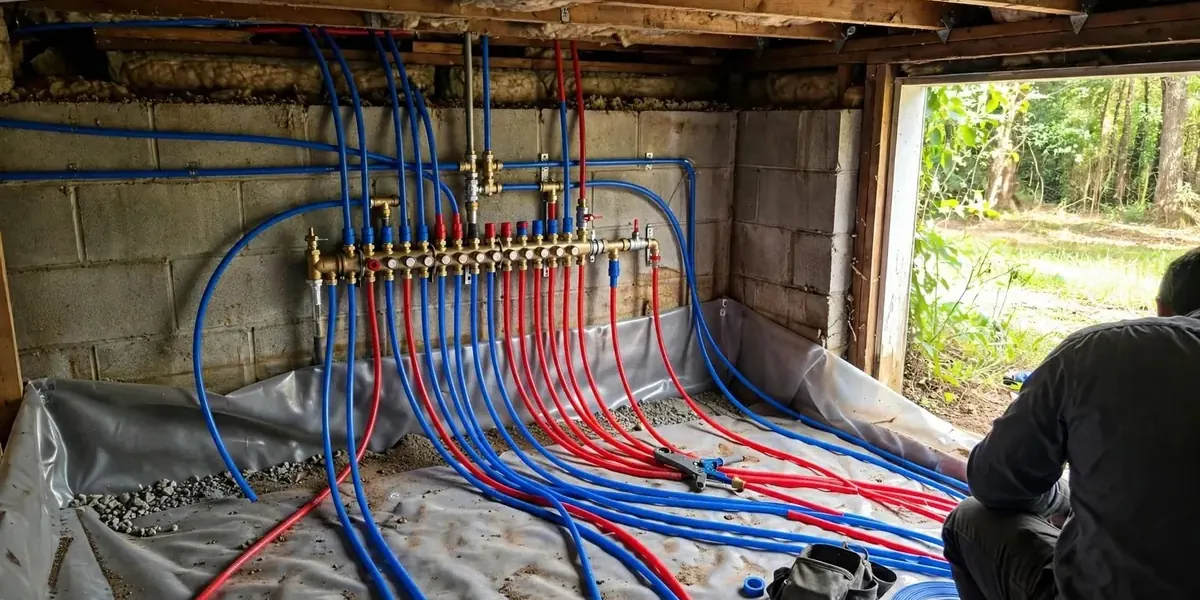
What a repipe replaces and what it leaves alone
A repipe swaps the pressurized supply lines that feed sinks, showers, toilets, the water heater and hose bibs. It does not touch the drain lines that carry waste out. Those are a separate system with different materials and different failure modes.
Most whole-house jobs on a single-story house take two to four days. Walls are opened with small access holes, not torn out. PEX is flexible and snakes through framing, so patches are often a few inches to a foot across. Ask what finish work is included.
Signs your supply pipes are near the end
Check exposed pipe in a garage, basement or under a sink first. A magnet sticks to galvanized steel but not to copper or plastic.
- Water runs brown or orange after sitting overnight, then clears after a minute.
- Pressure is weak at every fixture, because rust narrows galvanized pipe from the inside.
- Pinhole leaks keep appearing in new spots on copper, often with green or white crust at joints.
- A second leak shows up within months of fixing the first.
- Gray, threaded pipe that a magnet grabs is galvanized steel, and it is rarely sound past 60 years.
Supply pipe materials compared
Lifespans below are typical ranges, not a promise for any one house.
| Material | Typical life | Strength | Watch for |
|---|---|---|---|
| Galvanized steel | 40 to 60 years | Strong when new | Rust inside cuts pressure, then leaks at threads |
| Copper | 50 years or more | Long record, handles heat | Pinholes and failing solder joints |
| PEX | About 40 to 50 years | Few joints, tolerates a freeze better than rigid pipe | Sunlight damage and mismatched fittings |
| Polybutylene (gray plastic) | Often fails early | Cheap when installed from 1978 to 1995 | Replace before it leaks, not after |
Material choice changes the quote more than any other single decision.
Cracked or broken pipe: patch it or repipe?
A cracked or broken pipe is the most common reason people ask about repiping. One failure rarely justifies a whole-house job. If the rest of the pipe is sound, a plumber cuts out the damaged section and splices in new pipe for a fraction of the cost. If water is pouring right now, shut the main first and read about stopping a burst pipe.
The answer changes when the break is a symptom. Galvanized pipe that splits at one threaded joint is usually rusted at the rest. Copper with its third pinhole in a year is telling you about the whole run. A pressure test and a look inside a cut-out section show which case you have: clean inside means repair the spot, crusted solid means plan the repipe.
What Mauldin's history and rules mean for a repipe
Mauldin grew as its utilities arrived. Greenville Water lines reached Laurens Road in 1953, and US 276 was built through the center of town in 1956, per the city's own history. Houses from that first wave can still have steel supply pipe, but many were piped in copper, so a house's age proves nothing. Look at the pipe itself.
A repipe replaces a plumbing system, and the City of Mauldin Building and Zoning office states that a permit is required before you add, alter or replace one. Contractors must be licensed, bonded and insured and hold the permit before starting. Ask to see it before the first cut.
Code applies as well. Mauldin enforces the 2021 South Carolina Plumbing Code (or the 2021 International Plumbing Code with SC modifications) locally, since January 1, 2023. The 2024 codes are scheduled for January 1, 2027, so a job that slips toward that date is worth asking about.
Source type: City of Mauldin history and Building and Zoning page, SC LLR Building Codes Council.
How a whole-house repipe usually runs
- 1
Walk the house
The plumber traces the existing lines, counts fixtures and picks a route. Attic and crawlspace access save the most wall cutting.
- 2
Run the new lines
New PEX or copper goes to each fixture, with shutoff valves added where the old system had none.
- 3
Pressure test
The system is filled and held under test pressure while every joint and the gauge are checked.
- 4
Inspect and patch
If your permit calls for an inspection, it happens before walls are closed. Access holes are patched after.
Cast iron drain pipe is a different job
Cast iron was the standard material for home drain lines in houses built up to roughly the 1970s, and it can last 50 to 75 years. Inside, it grows rough scale that catches paper and grease, so slow drains and repeat clogs are the warning. Cracks and rust-through at joints show up in crawlspaces and under slabs.
A sewer camera inspection shows how bad the scale is. If the pipe is rough but sound, hydro jetting can clear it, or a liner can be cured inside it. If it is cracked, collapsed or offset, sections are cut out and replaced with PVC or ABS. Lining is the wrong call for a collapsed pipe.
What changes the price of a repipe
Whole-house repipes in the U.S. typically run about $4,000 to $15,000. Small single-story homes sit at the low end and large two-story homes with hard access at the high end. The real number comes from a call and a look at your house.
Insurance may respond to water damage from a sudden failure, but coverage for the pipe itself varies by policy, so ask your carrier. For a number on your house, call (855) 575-2890.
Repiping questions from Mauldin homeowners
Mauldin Building and Zoning says a permit is required before you add, alter or replace any plumbing system, so plan on one. The office is at 5 E. Butler Rd and can be reached at (864) 234-3475. A licensed, bonded and insured contractor should have the permit before starting.
Find a bare section under a sink or in a garage. Galvanized is dull gray, threaded at the joints and attracts a magnet. If you cannot find a bare section, a plumber can check at the water heater or main shutoff in a minute.
Residential plumbers are licensed through the SC Residential Builders Commission under LLR, and LLR has an online license lookup. Search the name before you sign. Commercial work over $10,000 falls under the Contractors' Licensing Board instead.
Yes. Lines under the concrete are usually abandoned and new lines are routed through the attic or walls, which avoids breaking the floor. If one slab line is leaking, slab leak repair may be the cheaper route.
Only if a camera inspection shows they are failing. Sound cast iron with light scale can be cleaned and left alone. Replacing drains is a separate quote and often a separate day.
Shut off the main, open a low faucet to relieve pressure and call the 24/7 line at (855) 575-2890. The same dispatch covers Simpsonville and nearby towns if you own property outside Mauldin.