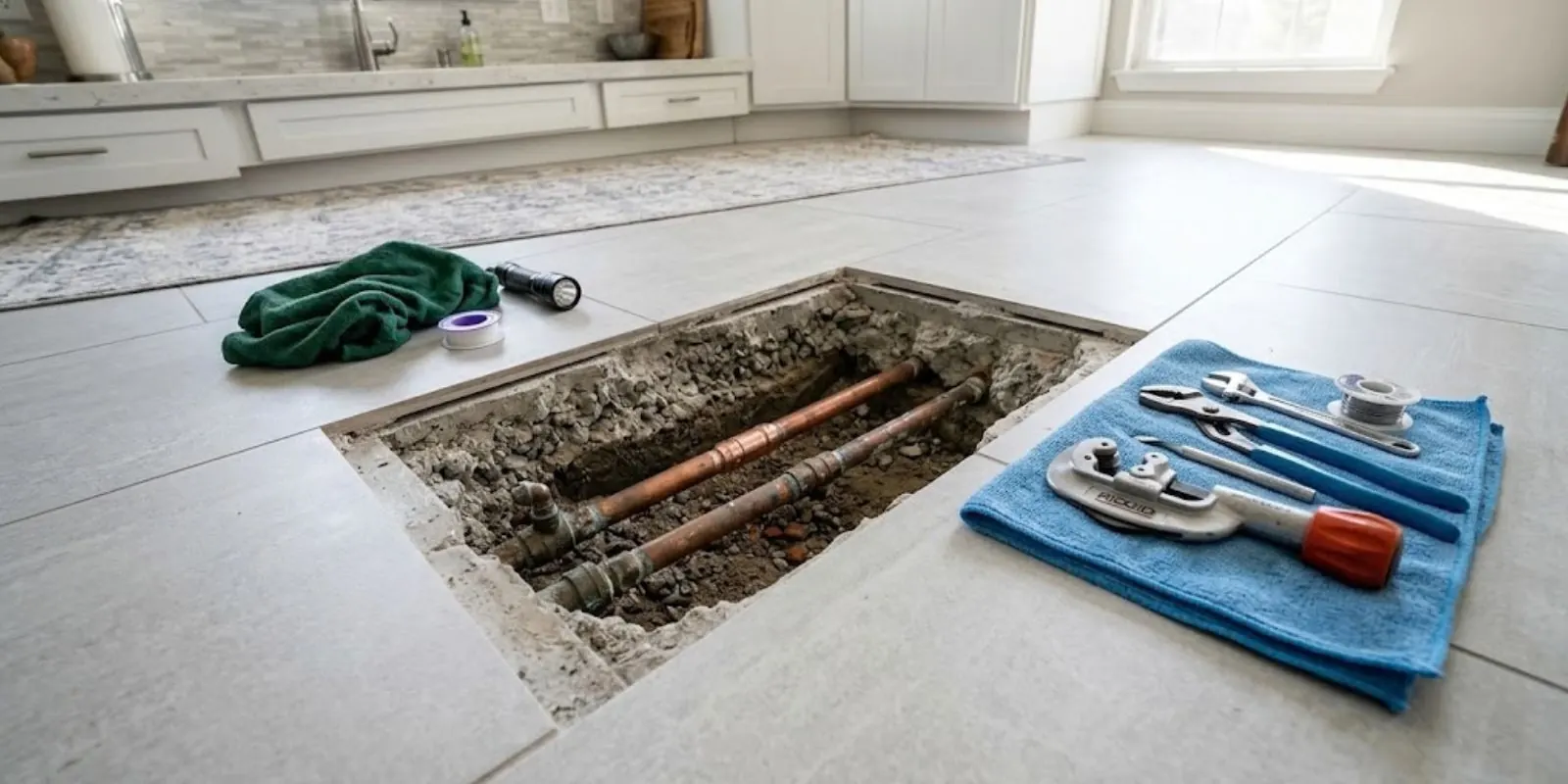
Typical price by repair method
These are rough national ranges for one leak on a single-story home, labelled as typical. Real slab leak repair quotes differ.
| Method | Typical range | Best fit | Main trade-off |
|---|---|---|---|
| Spot repair through the slab | $1,500 to $4,500 | One leak, easy to reach, pipe otherwise sound | Concrete is cut, and the next pinhole may be elsewhere |
| Re-route the line overhead or through walls | $2,000 to $6,000 | Corroded or repeated leaks on one supply run | Opens ceilings or walls, and drywall needs finishing |
| Epoxy coating inside the pipe | $3,000 to $8,000 | Pipes with several pinholes, floors you want left alone | Needs clean, round pipe and it cannot fix a split fitting |
| Tunnel under the slab | $2,500 to $6,500 | Leak at the slab edge or under a slab beam | Skilled labor, and soil conditions can limit it |
| Detection only | $150 to $800 | Unknown location, before any cutting | No repair, but it prevents wrong cuts |
Typical U.S. ranges. These exclude flooring, fixtures and water mitigation unless a quote says otherwise.
Why the range is so wide
Two slab leaks can cost three times apart even in the same neighborhood. The difference is rarely the pipe. It is almost always what sits on top of the pipe and how deep the break is.
Tile over a breached slab costs more to restore than carpet. A leak under a kitchen island is harder to reach than one in a hallway. A hot-water line near the water heater is a different job from a cold line near the front wall. Each of these changes the bill, and the factors below sort them out.
What moves the price up or down
Five things decide most quotes, and a plumber can explain each one after looking at the leak.
Insurance is a separate question. Coverage for slab leaks varies by policy. Many policies cover sudden, accidental water damage but not the cost of finding or fixing a slow, long-term leak, and some cover only burst pipes. Ask your carrier before work starts and keep photos and the plumber's written findings.
For a quote that matches your floor and pipe, call (855) 575-2890.
Mauldin numbers that put a repair bill in context
Census QuickFacts reports a median owner-occupied home value of $258,500 for Mauldin (2020 to 2024), with 68.0 percent of homes owner-occupied. A $3,000 spot repair is about 1 percent of that median value, which is a useful gut check. Skipping the repair while water saturates the slab and the subfloor can cost far more later.
The ground matters too. Red clay soils are common across the SC Piedmont, and the USDA Cecil series description puts the red clay layer 8 to 26 inches down. Clay can hold water near a slab, so a slab leak may not show up outside for a while. Do not wait for a puddle, because a spinning meter and a warm floor spot are the earlier clues.
Source type: U.S. Census QuickFacts and USDA Cecil series description.
A repair that looks cheap can turn expensive
The cheapest quote often covers only the visible leak. If the pipe is old and corroded, another pinhole may open within months, and each new break repeats the demolition and the floor repair. That is how a $2,000 fix becomes $6,000 spread across a few years.
Ask the plumber why a spot repair is the right choice for your pipe, and what condition the neighboring pipe is in. If the answer is vague, ask for the camera or pressure-test findings. An honest quote explains when it would recommend a whole-run replacement of the supply lines instead.
How to keep the cost down once you suspect a slab leak
- 1
Shut off the water at the main
Stopping the flow protects the subfloor and limits mitigation costs. Turn the main off at the house or at the meter shutoff if you can reach it.
- 2
Document everything
Photograph the meter, warm spots, damp baseboards and any stains. Write down the time you noticed each.
- 3
Call the insurer early
Ask what the policy says about slab leaks and water damage, and whether detection is covered.
- 4
Pay for detection first
Pinpointing before cutting avoids a wrong hole and a second restoration.
- 5
Compare the written scopes
Line up what each quote includes: access, concrete, flooring, permit, mitigation. Prices mean little without a scope.
Signs that tell you a slab leak is real
The classic clues are a water meter that moves with everything off, a warm patch on a floor, the sound of running water in a quiet house, and a sudden jump in the bill. Damp carpet at the edge, a musty smell and cracks in tile can also appear.
None of these proves a slab leak. A leaking toilet or an irrigation zone can mimic several of them. A plumber confirms with a pressure test and listening gear before quoting any cutting.
Before you sign off on a slab leak quote
- The leak location is documented, not estimated.
- The quote names the method and why it fits your pipe.
- Flooring, drywall and cleanup are listed as included or excluded.
- Permit handling is stated, and rules in Mauldin are confirmed with Building and Zoning.
- Warranty terms on the repair are in writing.
- Payment terms and what happens if the leak turns out to be elsewhere are clear.
DIY, patches and the point where you call
A homeowner can find the meter, shut the main and photograph the signs. Pressure testing, pinpointing and cutting concrete are not DIY jobs. Cutting a slab can hit a post-tension cable or another line, and a mistake adds thousands.
Epoxy kits sold for homeowners are meant for exposed pipe, not slab lines. Call a plumber as soon as you suspect a slab leak, because water under a slab keeps working while you decide. Slab leaks happen in homes across Taylors and Greenville as well, and the cost logic is the same.
Slab leak cost questions from Mauldin homeowners
No. A cheap spot repair fits one leak in a healthy pipe. When the neighboring pipe is corroded, another leak can open within months. Weigh the quote against the pipe's condition, not only the price.
It depends on the policy. Some cover sudden and accidental damage but not the repair of a slow leak, and some cover only burst pipes. Read the water damage section and ask the carrier before work starts.
It can be a large share on tile or hardwood, since stone and wood add labor and matching material. The quote should say whether flooring is included. Carpet is cheaper to lift and replace than tile.
Some companies credit it, some do not. Ask before the visit. A detection fee typically runs a few hundred dollars and prevents cutting in the wrong place.
It depends on the size of the leak. A pinhole can run for months, soaking the slab and subfloor. A large break can damage flooring within hours. Shutting the main is the safe first move.
There is no local statistic to cite. What is known is that Mauldin homes were built across several decades, so some have older supply pipe. Age and pipe material matter more than the town.
Red clay soils are common across the SC Piedmont per the USDA Cecil series. Clay can hold water near the slab, which can hide a leak at the surface for longer. It does not cause leaks, but it can delay the signs.