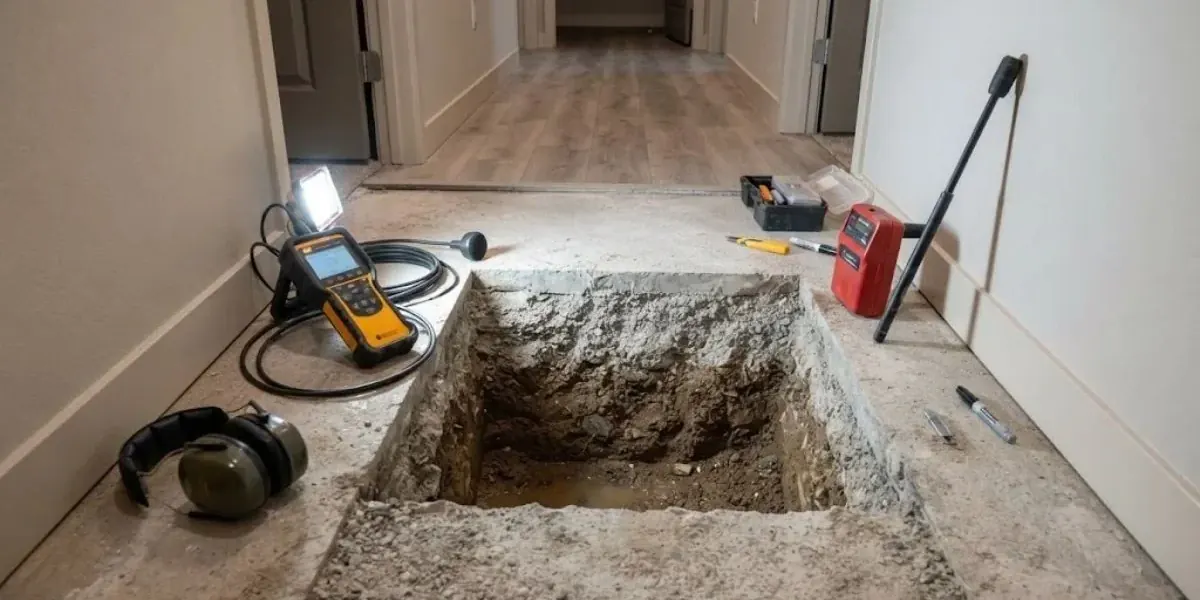
The short answer on trenchless and slab leaks
Trenchless methods were built mainly for buried pipes like sewer lines, where a liner can be pulled through the old pipe. A slab leak is usually in a pressurized hot or cold supply line, often copper, and those lines have tight bends and many fittings that make lining harder.
That does not leave you with only a jackhammer. You have four real choices, and the right one depends on where the leak is, how old the piping is and whether more leaks are likely. A licensed plumber on a slab leak repair call should explain all four, not only the one they sell.
Four ways to fix a leak under the slab
| Option | How it works | Best when | Main drawback |
|---|---|---|---|
| Spot repair through the floor | Cut a small opening in the slab above the leak and replace that section | One located leak in otherwise sound pipe | Floor finish must be patched, and other leaks can follow |
| Tunnel under the slab | Dig in from outside or a crawlspace and reach the pipe from below | The leak is near an exterior edge or the layout allows it | Not practical in the middle of a slab |
| Re-route overhead | Abandon the slab line and run new pipe through walls or the attic | Pipe is old or has leaked more than once | Opens walls and ceilings, with repainting afterward |
| Epoxy lining | A resin coating is cured inside the existing pipe | Pipe is sound, access is available at both ends | Limited by fittings, and not every plumber offers it |
Cost and availability vary by house. Ask which options are physically possible for your layout.
Confirm the leak before you spend a dollar on repair
Greenville Water maintains the line up to the outlet side of the meter. Its customer service page states that the line leaving the meter is the customer's to maintain, so these checks are yours to run.
- 1
Stop all water use
Turn off faucets, ice makers and irrigation. Make sure no toilet is running.
- 2
Read the meter
Note the reading, wait at least 15 minutes without using water, and look again. Movement means water is leaking somewhere.
- 3
Shut the house cutoff
If the outdoor meter still runs with the house valve closed, the leak is between the meter and the house, not under the slab.
- 4
Check the toilets
Add food coloring to each tank without flushing. Colored water in the bowl after an hour or more means a toilet leak.
- 5
Look for slab signs
Warm spots on the floor, the sound of running water in silence, damp carpet edges and a sudden jump in your bill all point toward the slab.
What red clay soil means for a Mauldin slab leak
Red clay soils are common across the South Carolina Piedmont, and the USDA Cecil series description records a clay layer starting 8 to 26 inches down. We cannot say it is the dominant soil under your lot, but if it is, the clay holds moisture and drains slowly.
That matters for a slab leak. Water escaping from a line may not surface in the yard or at the slab edge for a long time, so a wet spot is a poor guide to where the pipe is broken. Have a plumber pinpoint it with listening gear or a thermal camera before anyone cuts, because guessing wrong turns one hole into three.
Source type: USDA Cecil series description and Greenville Water customer service page.
When trenchless-style lining is and is not worth it
Lining makes sense when the pipe is otherwise in good shape and you want to avoid opening walls. It is a poor fit when the pipe has pinholes in several places, when fittings are corroded or when the line has been patched many times. In those cases the coating has little solid pipe to bond to.
If your home has copper that has pinholed in more than one spot, a re-route or a whole-house repipe is often the more honest recommendation. It costs more up front and removes the repeat visits.
What drives the cost of a slab leak repair
Typical U.S. ranges are wide. Spot repair often lands in the low thousands, re-routes are usually higher, and lining can be in the same range as a re-route. Your actual price comes from a call and a site visit.
Home insurance coverage for slab leaks varies by policy. Ask your carrier before work starts, and keep photos. For a clear price, call (855) 575-2890.
When to call a plumber and what you can do first
Run the meter test yourself, but leave the cutting to a professional.
- Call if the meter moves with everything off and the house cutoff closed.
- Close the main shutoff to the house if water is visibly spreading.
- Do not drill or chip the floor to look for the pipe.
- Move rugs and furniture off any warm or damp area.
- If a hot-water slab leak is suspected, ask a plumber whether the water heater should be shut off. Do not guess.
If you live just outside the city, the dispatch line also covers Fountain Inn and Taylors, so you can reach a licensed plumber from there too.
Slab leak questions from Mauldin homeowners
Yes. Greenville Water maintains the line up to the outlet side of the meter, and everything past it, including a service line under your slab, is the homeowner's responsibility. Your first call should go to a licensed plumber, not the utility.
Sometimes. A re-route runs new pipe overhead, a tunnel can reach the line from outside and epoxy lining works inside the existing pipe. Which one fits depends on location, pipe condition and access.
It can be. If water is spreading, shut off the main. A hidden leak that is not spreading still wastes water and can undermine flooring, so do not wait weeks.
Shut the house cutoff valve and watch the meter. If it keeps moving, the leak is in the buried line before the house. If it stops, the leak is inside, and a slab leak is one possibility.
Not if it is done cleanly. The new pipe is in the walls or attic and the old slab line is capped. Keep the invoice and a drawing of the new routing for future buyers.
Coverage varies a lot. Many policies cover resulting water damage but not the pipe itself. Call your carrier before repairs and ask what they need to see.